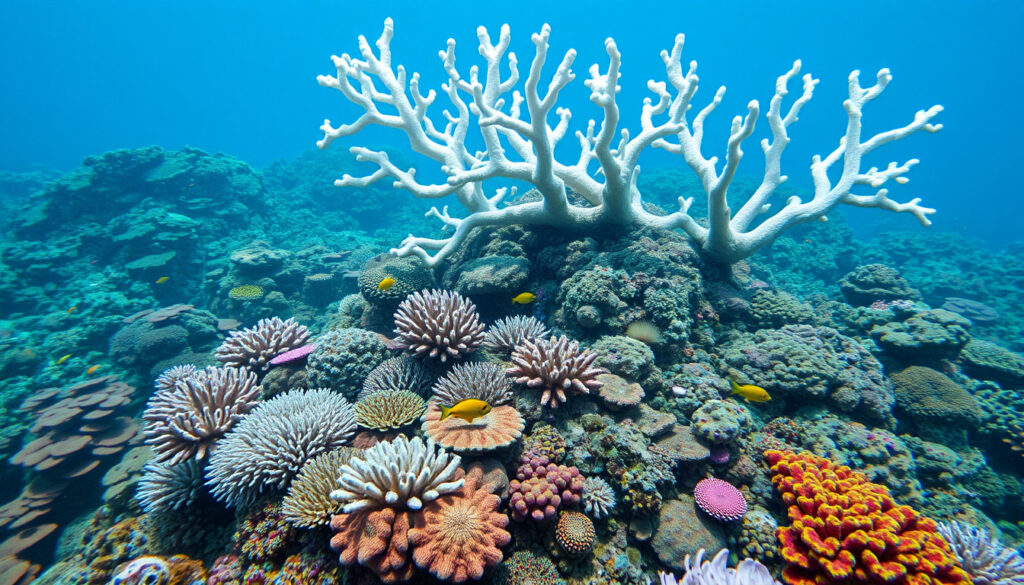
Coral Reefs: Definition, Largest Reefs, and Why They Are Dying
Coral reefs, often called the rainforests of the sea, are underwater ecosystems built by tiny animals called polyps. They cover less than 0.1% of the ocean floor yet support roughly a quarter of all marine life, and this guide walks through what they are, where the biggest ones are, why they are dying, and what can be done.
Reef-building coral species worldwide: Approximately 800 known species ·
Percentage of ocean species dependent on reefs: around 25% ·
Area of coral reefs lost in the last 30 years: approximately 50% according to NOAA ·
Largest reef system: Great Barrier Reef, Australia (~2,300 km) ·
Countries with the most extensive reefs: Indonesia, Australia, Philippines
Quick snapshot
- Coral reefs are built by coral polyps that secrete calcium carbonate (NOAA Fisheries (U.S. federal fisheries authority))
- Reefs cover less than 1% of the ocean floor but host ~25% of marine species (NOAA Fisheries) (NOAA Fisheries (U.S. federal fisheries authority))
- The Great Barrier Reef is the world’s largest reef system (Great Barrier Reef Foundation (leading Australian reef charity))
- Climate change is the biggest threat to coral reefs globally (US EPA (U.S. environmental regulatory agency))
- Exactly how many reef species are currently endangered
- Whether global reef loss can be reversed with current interventions
- The precise economic value of all reef services
- Whether cold-water reefs are as vulnerable as tropical ones
- 1998: First major global bleaching event killed ~16% of reefs
- 2014–2017: Third global bleaching event — longest on record
- 2024: Reef decline continues; restoration projects ongoing but limited
- IPCC projects further 70%–90% decline at 1.5°C warming
- Marine protected areas and restoration are key interventions
- Continued monitoring by NOAA and AIMS
The following table summarizes key figures that define the scale and stakes of coral reefs.
| Measure | Value |
|---|---|
| Number of reef-building coral species | Approximately 800 |
| Ocean area covered by reefs | Less than 0.1% |
| Marine species depending on reefs | ~25% |
| Reef area lost in last 30 years | ~50% |
| Economic value of coral reefs annually | Estimated $375 billion (global) |
| Number of people dependent on reefs | Over 500 million |
What is a coral reef?
A coral reef is an underwater ecosystem built by colonies of tiny animals called coral polyps. These polyps secrete a hard skeleton made of calcium carbonate, which accumulates over centuries to form the massive structures we call reefs. According to NOAA Fisheries, corals are vulnerable to pollution, climate change, sedimentation, and fishing — factors that can cripple an entire reef.
How coral reefs are built
- Each coral polyp is a sac-like animal with a central mouth surrounded by tentacles
- Polyps extract calcium ions from seawater to build a calcium carbonate skeleton beneath them
- Over time, new polyps settle on top of old skeletons, creating a growing structure
Most reef-building corals rely on symbiotic algae called zooxanthellae. These algae live inside the polyp’s tissue and supply up to 90% of its energy through photosynthesis, in exchange for shelter. The partnership is so efficient that a single square meter of healthy reef can produce more biomass than a comparable patch of rainforest.
The implication: coral reefs are not just rocks — they are living, growing systems where every layer is the product of a biological pact between animal and alga.
Corals get food from their algae, but only in clear, sunlit water. That means tropical reefs thrive where water is shallow and clean — and that same proximity to land exposes them to pollution and sediment runoff.
Difference between warm-water and cold-water reefs
Most people picture warm, sunlit tropical reefs — the kind off Australia or the Caribbean — but cold-water reefs also exist in deep, dark waters. According to research from the Smithsonian Ocean Portal (science communication arm of the Smithsonian Institution), cold-water corals grow in water as cold as 4°C and as deep as 6,000 meters. They do not need sunlight because they lack zooxanthellae and instead capture food particles from the water column. While they are less studied, they are also threatened by ocean acidification and deep-sea trawling.
The implication: coral reefs are living systems whose survival hinges on water quality and climate stability.
What are the top 3 largest coral reefs in the world?
Three reef systems dwarf all others in scale, and each is a UNESCO World Heritage Site. Their sheer size is staggering: one is visible from space.
Great Barrier Reef (Australia)
- Stretches over 2,300 km along Australia’s northeast coast
- Composed of more than 2,900 individual reef systems and about 900 islands
- Visible from space, according to the Great Barrier Reef Foundation
Mesoamerican Barrier Reef (Caribbean)
- Runs approximately 1,000 km along the coasts of Mexico, Belize, Guatemala, and Honduras
- Second largest barrier reef in the world
- A UNESCO World Heritage site and a critical habitat for sea turtles and manatees
New Caledonia Barrier Reef (Pacific)
- Located off New Caledonia in the South Pacific, spanning about 1,500 km
- One of the most intact reef systems in the world, with high biodiversity
- Also a UNESCO World Heritage site
What this means: size alone does not guarantee safety. Even the largest reefs are under compounding stress from warming waters, pollution, and storms.
Are coral reefs still dying?
Yes — and the data is sobering. According to NOAA Ocean Service (U.S. federal ocean authority), approximately 50% of the world’s coral reefs have been lost since the 1980s. The trend is accelerating.
Current state of coral reef health
In 1998, the first major global bleaching event killed an estimated 16% of the world’s reefs, as recorded by NOAA Coral Reef Conservation Program (U.S. federal reef monitoring body). A second event struck in 2010, and a third — the longest on record — ran from 2014 to 2017. The Great Barrier Reef alone experienced three mass bleaching events in five years up to 2020. The IPCC projects that at 1.5°C of additional warming, reefs could decline by 70% to 90%, and losses could exceed 99% at 2°C. That projection comes from analysis published in the Taylor & Francis journal (peer-reviewed academic publication).
Major causes of coral bleaching
- Rising sea temperatures: heat stress causes corals to expel their symbiotic algae, turning them white
- Ocean acidification: increased CO₂ lowers seawater pH, reducing the availability of carbonate ions corals need to build skeletons
- Pollution: nutrient runoff from agriculture and sewage leads to algal overgrowth that smothers reefs
- Overfishing: removal of herbivorous fish disrupts the ecological balance that keeps algae in check
According to the US EPA, increased ocean temperatures and changing chemistry are the greatest global threats. In the Great Barrier Reef, the Queensland Government (Australian state environmental department) similarly names climate change as the biggest threat, then adds poor water quality, crown-of-thorns starfish outbreaks, fishing, and coastal development.
Even if we stopped all CO₂ emissions today, the warming already locked into the system would cause further bleaching. The reef’s survival depends not on prevention — but on how fast we can slow the damage.
Efforts to restore damaged reefs
Restoration projects are underway globally. These include coral nurseries, where fragments are grown in protected areas and then transplanted onto degraded reefs. The WWF Australia (global conservation organization’s Australian branch) supports marine protected areas, sustainable fishing practices, and efforts to reduce pollution. The Great Barrier Reef Marine Park Authority — Australia’s federal reef management body — also targets marine debris as a major threat. However, restoration can only buy time; it does not address the root cause.
The catch: the window for effective action is narrowing with each passing decade.
What are 5 interesting facts about coral reefs?
- Coral reefs are called the rainforests of the sea for good reason: they occupy less than 0.1% of the ocean floor but support roughly 25% of all marine species, according to NOAA Fisheries.
- Some coral colonies can live for hundreds of years. Individual polyps die and are replaced, but the colony itself persists.
- Corals get most of their energy from symbiotic algae (zooxanthellae), which live inside their tissue and photosynthesize.
- Coral reefs protect coastlines by absorbing wave energy from storms and tsunamis, reducing erosion and property damage.
- The economic value of coral reefs worldwide is estimated at $375 billion annually, supporting tourism, fisheries, and coastal protection for over 500 million people.
The pattern: these facts all point to the same conclusion — coral reefs punch far above their weight in ecological and economic terms, which makes their decline all the more consequential.
What is the biggest killer of coral reefs?
One threat dominates all others: climate change. It acts through two primary mechanisms: rising sea temperatures and ocean acidification. According to the Great Barrier Reef Foundation, increased water temperatures, poor water quality, severe cyclones, and crown-of-thorns starfish outbreaks combine into what they call a “perfect storm” for reefs.
Climate change and rising sea temperatures
When water temperatures rise even 1–2°C above normal, corals expel their zooxanthellae in a process called bleaching. If the stress persists, the coral dies. Global bleaching events — in 1998, 2010, and 2014–2017 — have grown more frequent and severe. Queensland Government scientists confirmed that climate change is the foremost threat to the Great Barrier Reef.
Ocean acidification
Oceans absorb about 30% of the CO₂ released by human activity. As CO₂ dissolves, it lowers the pH of seawater — a process that reduces the availability of carbonate ions. Corals need carbonate to build their calcium carbonate skeletons. Acidification does not kill corals directly; it makes their skeletons weaker, slower to grow, and more vulnerable to erosion and storms.
Pollution and coastal development
Land-based pollution — including agricultural runoff, sewage, and sediment from construction — clouds the water and smothers coral polyps. According to the Great Barrier Reef Marine Park Authority, marine debris is a major threat to reef wildlife. Nutrient overload from fertilizers also feeds algae that outcompete corals for space and light.
Overfishing removes the herbivorous fish that naturally keep algae in check. Remove the grazers, and algae takes over. The result: a reef that was already stressed by temperature and acidification can be overwhelmed by algae in a matter of months.
The overall pattern is clear: climate change is the dominant threat, and addressing it is essential for reef survival.
Timeline: Coral reef decline in six events
First significant coral bleaching events recorded globally
Major global bleaching event, killed ~16% of world’s reefs
Another major bleaching event, especially in Southeast Asia
Third global bleaching event, longest on record
Great Barrier Reef experiences third mass bleaching in 5 years
Ongoing coral restoration projects; reef decline continues globally
The catch: the intervals between bleaching events are shrinking. What was once a once-in-a-decade crisis is now a recurring, multi-year threat.
“Coral reefs are the foundation of the ocean’s food web. When we lose them, we lose the entire ecosystem.”
— NOAA Ocean Service (U.S. federal ocean authority)
“The Great Barrier Reef is a global treasure, and it is under grave threat. The decisions we make in the next decade will determine its fate.”
— Great Barrier Reef Foundation (leading Australian reef charity)
“Coral reefs support a quarter of all marine life and half a billion people. Their loss would be catastrophic for both biodiversity and human livelihoods.”
— WWF Australia (global conservation organization’s Australian branch)
“Even the most robust restoration efforts can only buy time. Without global action on climate change, coral reefs as we know them will not survive.”
— NOAA Fisheries (U.S. federal fisheries authority)
The coral reef story is not just about biology — it is about a system that supports 500 million people, shields coastlines from storms, and holds $375 billion in annual value. The data is clear: reefs are dying, and the window to change course is closing. For governments in reef nations like Australia and Indonesia, the choice is stark: accelerate emissions cuts and protect marine reserves, or watch these living cities turn to rubble.
Related reading: SpongeBob SquarePants Fan Theories · Mr. Krabs: Character Analysis, Species, Age & Voice Actor
Frequently asked questions
What is the difference between a coral and a coral reef?
A coral is an individual animal (a polyp) or a colony of polyps. A coral reef is the large, complex structure built over centuries by those colonies as they secrete calcium carbonate skeletons. Individual corals can exist without forming a reef, but reefs are made of corals.
How long does it take for a coral reef to form?
Reefs grow very slowly — typically 1 to 10 centimeters per year for branching corals, and even slower for massive boulder corals. A fully mature reef can take thousands to millions of years to develop.
Can corals move?
No. Adult coral polyps are permanently attached to the skeleton they build. However, coral larvae (planulae) can swim freely for a few days to weeks before settling down and metamorphosing into a polyp.
What causes coral bleaching?
Bleaching occurs when corals are stressed by factors like high water temperature or pollution. They expel the symbiotic algae (zooxanthellae) living in their tissues, turning white. If the stress persists, the coral dies.
Is it safe to touch coral reefs while swimming?
No. Touching corals can damage their thin outer tissue layer, stress the colony, and introduce bacteria. It is also illegal in many protected areas. Always observe from a distance without contact.
Do all corals build reefs?
No. Only “hermatypic” (reef-building) corals — those that have symbiotic algae and secrete a hard skeleton — build substantial reefs. “Ahermatypic” corals lack algae and do not form reef structures.
Are there coral reefs in cold water?
Yes. Cold-water corals grow in deep, dark ocean waters as cold as 4°C. They lack photosynthetic algae and capture food from the water instead. They build reefs much more slowly than warm-water corals and are also threatened by acidification and bottom trawling.
What countries have the most reef area?
Indonesia has the largest coral reef area of any country, followed by Australia and the Philippines. Together they account for a substantial share of the world’s reef cover.
For the 500 million people who depend on coral reefs for food, income, and coastal protection, and for the governments of countries like Australia, Indonesia, and the Philippines that manage these ecosystems, the implication is clear: cut emissions, reduce local stressors, and invest in restoration now — or watch the forests of the sea vanish within a generation.
More related posts
 Emma Grede Net Worth, Biography, Husband & Her Empire
 Fireboy and Watergirl Unblocked: How to Play Online for Free
 Jason Robertson: Ethnicity, Contract, Injury, Stats & More
 What Does OG Mean? Slang Definition and Usage Guide
 Gregg Allman: Cher’s Tributes, Death Cause, and Their Marriage
 Squid Game Season 3 – Release Date Cast Episodes Trailers
 Ray Dalio: Biography, Net Worth, Principles & Buffett Debate
 Donny Osmond: Health, Family, and Net Worth Facts