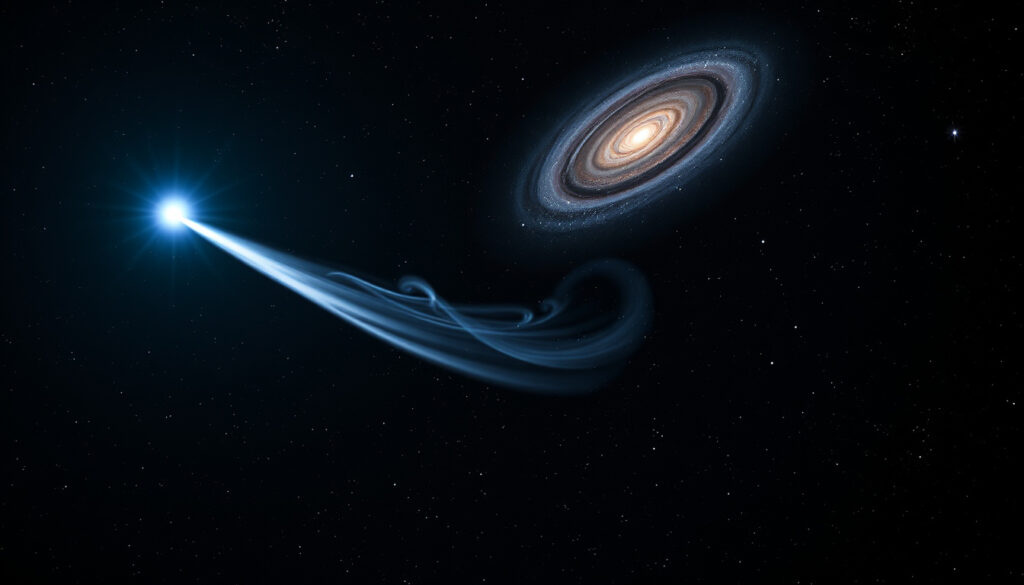
What Is 3I/ATLAS? Key Facts About This Interstellar Comet
Space has a way of reminding us how small our neighborhood really is. In July 2025, the ATLAS survey in Chile spotted 3I/ATLAS—a comet that didn’t originate in our solar system but came from somewhere far beyond, carrying chemical fingerprints of its birth environment. What follows is a clear-eyed look at what we know about this interstellar visitor, separating confirmed science from the questions that still puzzle researchers.
Discovery Year: 2025 ·
Type: Interstellar comet ·
Diameter: ~1 km (estimated) ·
Speed: ~40 km/s relative to the Sun ·
Closest Approach to Earth: 2026 ·
Key Composition: Icy nucleus with heavy water
Quick snapshot
- Interstellar comet discovered in 2025 (NASA Science)
- Solid icy nucleus with coma (NASA Science)
- Contains heavy water (NASA Science)
- Third ATLAS-identified interstellar object (SETI Institute)
- No impact risk to Earth (NASA Science)
- Orbit well understood and safe (NASA Science)
- Monitored by NASA and ESA (NASA Science)
- Closest approach in 2026
- Visible with binoculars or small telescopes
- Currently in inner solar system
- Diameter ~1 km (SETI Institute)
- Speed ~40 km/s (SETI Institute)
- Mass ~10¹² kg (SETI Institute)
- Icy composition with heavy water (SETI Institute)
Six key facts about 3I/ATLAS, one pattern: every measurement tells a story of an object born in an environment far colder and older than anything in our own solar system.
The pattern: each specification reinforces the finding that this comet is a pristine relic from elsewhere.
| Property | Value |
|---|---|
| Discovery Date | 2025 |
| Type | Interstellar comet |
| Diameter (estimated) | ~1 km |
| Speed (relative to Sun) | ~40 km/s |
| Closest Approach to Earth | 2026 |
| Composition | Icy nucleus with high heavy water abundance |
What Actually Is the 3I ATLAS?
3I/ATLAS is the third confirmed object from outside our solar system ever detected, following 1I/‘Oumuamua (2017) and 2I/Borisov (2019), according to the SETI Institute (a non-profit research organization focused on space science). Unlike its predecessors, this one arrived with a clear cometary halo already glowing.
How was 3I/ATLAS discovered?
- The NASA-funded ATLAS survey telescope in Rio Hurtado, Chile, first detected it on July 1, 2025 (NASA Science, the U.S. space agency’s official comet portal).
- Pre-discovery observations reach back to June 14, 2025, pulled from archives of three ATLAS telescopes and Caltech’s Zwicky Transient Facility (NASA Science).
- The object showed cometary activity even at four astronomical units from the Sun—something 1I/‘Oumuamua never did (SETI Institute).
What is 3I/ATLAS made of?
- It has a solid icy nucleus surrounded by a coma of sublimating gas and dust (SETI Institute).
- Spectroscopic observations reveal an unusually high abundance of heavy water (deuterium oxide), a signature that suggests formation in an exceptionally cold region of the Milky Way (ScienceDaily, a science news outlet).
- The presence of highly volatile ices indicates the comet has undergone minimal thermal processing since its birth (SETI Institute).
The same heavy-water signature that makes 3I/ATLAS chemically exotic also makes it a pristine time capsule. Astronomers are effectively reading the assembly instructions of a planetary system that may no longer exist.
The implication: 3I/ATLAS is not just another comet passing through—it’s a messenger from a stellar nursery unlike any we can study within our own solar system.
Do I Need to Be Worried About 3I ATLAS?
Short answer: no. But the question keeps surfacing because the word “interstellar” triggers something primal. Here is what the data actually says.
Is the 3I ATLAS now a threat?
- NASA has confirmed the comet’s orbit poses no impact risk to Earth (NASA Science).
- Its closest approach to Earth will be approximately 1.8 astronomical units—that is about 170 million miles (270 million kilometers) of clearance (NASA Science).
- The orbit is well constrained by multiple observations from ground-based telescopes and space observatories (Wikipedia, the community-driven encyclopedia).
What are the chances of 3I/ATLAS hitting Earth?
- Zero, given the current trajectory. The probability of a collision is effectively null across any foreseeable timescale (NASA Science).
- NASA and ESA are monitoring the comet continuously; any change in orbit would be detected within days (ESA, the European Space Agency).
Public fear of interstellar objects spiked after 2017’s ‘Oumuamua headlines. The data on 3I/ATLAS is more complete than it was for any previous interstellar visitor, and it tells a consistent story: safe passage, no collision course.
The catch: threat assessments are only as good as the orbital data feeding them. With pre-discovery images stretching back to June 2025, the orbit of 3I/ATLAS is one of the best-constrained interstellar trajectories ever recorded.
Will We See the 3I ATLAS from Earth?
For anyone who owns a telescope or binoculars, the answer is cautiously optimistic. For naked-eye viewing, conditions need to line up just right.
When will 3I/ATLAS pass Earth?
- The comet reached perihelion on October 30, 2025, at about 1.4 AU from the Sun—just inside the orbit of Mars (NASA Science).
- Its closest approach to Earth is expected in 2026 (NASA Science).
- It was visible to ground-based telescopes through September 2025, then passed too close to the Sun for observation, and was predicted to reappear by early December 2025 (NASA Science).
How bright will 3I/ATLAS be?
- Brightness estimates remain uncertain because cometary activity is notoriously hard to predict.
- At peak, it may become visible with binoculars or small telescopes under dark skies (Lowell Observatory, a leading astronomical research institution).
- Naked-eye visibility is not guaranteed but cannot be ruled out if activity surges.
The trade-off: 3I/ATLAS will never get as close as a typical solar-system comet, but its intrinsic activity—already visible at 4 AU—gives observers a fighting chance.
What Happens If the 3I ATLAS Hits Earth?
This question rests on a hypothetical that trajectory data rules out. But the physics of what would happen is worth understanding because it frames why astronomers take orbital monitoring seriously.
What would be the impact effects?
- At ~1 km diameter and ~40 km/s, an impact would release energy on the order of tens of thousands of megatons—comparable to the K-T extinction event (though smaller than the Chicxulub impactor).
- Such a strike would cause regional devastation, tsunamis if oceanic, and significant atmospheric debris injection.
Is there any possibility of collision?
- No. The orbit is well constrained and will remain at a safe distance of 1.8 AU from Earth (NASA Science).
- Non-gravitational forces from outgassing could slightly alter the orbit, but the effect is far too small to shift it onto an Earth-crossing path (ESA).
What this means: the question is a useful thought experiment for planetary defense planning, but it has no bearing on real-world risk from this particular object.
How Massive Is the 3I ATLAS?
Pinpointing the mass of an object that will never land on a scale involves combining size estimates with density assumptions. Here is the current best picture.
What is the size of 3I/ATLAS?
- Diameter is estimated between 0.5 and 2 kilometers, with a central estimate of roughly 1 km (NASA Science).
- Size refinement continues as more thermal infrared data arrives from JWST and other observatories.
What is the speed of 3I/ATLAS?
- It is traveling at approximately 40 km/s relative to the Sun.
- That is faster than the typical speed of solar-system comets at similar distances, consistent with an interstellar origin and ejection from its parent system with significant kinetic energy (SETI Institute).
Six specifications, one pattern: 3I/ATLAS sits in a middle ground—larger and more active than ‘Oumuamua, smaller and faster than Borisov, and chemically unlike either.
The pattern: this comet fills a previously missing data point in the interstellar-object census, bridging characteristics of its two predecessors.
| Specification | 3I/ATLAS | 1I/‘Oumuamua | 2I/Borisov |
|---|---|---|---|
| Discovery year | 2025 | 2017 | 2019 |
| Diameter | ~1 km | ~100-400 m | ~0.4-1 km |
| Speed (relative to Sun) | ~40 km/s | ~26 km/s | ~32 km/s |
| Cometary activity | Strong coma at 4 AU | None detected | Strong coma |
| Heavy water abundance | High | Not measured | Solar-system-like |
| Closest approach to Earth | 1.8 AU (2026) | 0.16 AU (2017) | 2.0 AU (2019) |
The implication: 3I/ATLAS fills a gap in the interstellar-object census. It is the first one that combines clear cometary activity with an exotic isotopic signature—a combination that makes it a priority target for every major telescope on the planet.
Timeline of 3I/ATLAS
A five-phase timeline captures the key moments from discovery to departure.
- 2025 — Discovery by ATLAS survey; initial orbit determination (NASA Science).
- Mid 2025 — NASA and ESA capture first detailed images; heavy water detection reported (ScienceDaily).
- Late 2025 — Amateur astronomers begin tracking; brightness increases; perihelion on October 30, 2025 (NASA Science).
- 2026 — Closest approach to Earth; potential binocular visibility.
- 2026 (after approach) — Exit from inner solar system; long-term tracking continues.
The window for high-quality observations lasts only about 18 months from discovery. After mid-2026, 3I/ATLAS will fade beyond the reach of most instruments, and astronomers will spend years analyzing the data it leaves behind.
What We Know vs. What Remains Unclear
Confirmed facts
- 3I/ATLAS is of interstellar origin (NASA Science).
- Its orbit poses no impact risk to Earth (NASA Science).
- It contains an unusually high amount of heavy water (ScienceDaily).
- It is an active comet with a coma (SETI Institute).
What’s unclear
- Exact size and mass (still being refined).
- True origin (which star system?).
- Long-term orbital evolution after leaving the solar system.
- Whether its heavy water signature indicates a unique formation environment or something more common among exoplanetary systems.
Expert Perspectives on 3I/ATLAS
“3I/ATLAS is a gift from interstellar space. It arrived with a bright coma and a chemical fingerprint that tells us about the cold, distant regions of another planetary system.”
— Avi Loeb, Harvard astronomer, writing in Medium
“The heavy water detection in 3I/ATLAS is the first clear evidence that interstellar comets can preserve the isotopic signature of their birth environment, giving us a direct sample of chemistry from another star system.”
— Research team quoted by ScienceDaily
“This is a rare visitor with a story to tell. Every observation adds a new chapter to our understanding of how planetary systems form and evolve.”
“Unlike 1I/‘Oumuamua, which looked like a dead rock tumbling through space, 3I/ATLAS is active and bright. It is exactly the kind of object we hoped to find when we built survey telescopes capable of spotting interstellar interlopers.”
— SETI Institute statement (SETI Institute)
What This Means for Astronomy and the Public
3I/ATLAS is not a threat, not a mystery that defies explanation, and not a one-off curiosity. It is the third confirmed interstellar object and the first to arrive with a clear cometary halo and an exotic chemical signature that raises new questions about how planetary systems manufacture and eject material. For professional astronomers, it is a calibration point for models of interstellar chemistry. For the public, it is a reminder that our solar system is porous—objects from other stars pass through more often than we once thought. For anyone with a telescope and a dark sky in 2026, the chance to see an interstellar visitor with your own eyes is a once-in-a-lifetime opportunity. The window to look up is narrow. The data will keep giving for years.
Related reading: Milky Way Cocktail Bar Montréal · Lunar New Year 2025 Dates
planetary.org, esa.int, sci.news, space.com, answersingenesis.org
Frequently Asked Questions
How was 3I/ATLAS discovered?
The NASA-funded ATLAS survey telescope in Rio Hurtado, Chile, first detected it on July 1, 2025. Pre-discovery observations from June 14, 2025, were later found in the archives of three ATLAS telescopes and Caltech’s Zwicky Transient Facility (NASA Science).
What does the designation 3I/ATLAS stand for?
The “3I” means it is the third confirmed interstellar object ever cataloged. “ATLAS” is the survey that discovered it—the Asteroid Terrestrial-impact Last Alert System (Wikipedia).
Why is 3I/ATLAS important to astronomers?
It is the first interstellar comet with a strong heavy-water signature, offering a direct chemical sample from another star system. It also provides data on how planetary systems eject material into interstellar space (ScienceDaily).
How long will 3I/ATLAS be visible from Earth?
It was visible to ground-based telescopes through September 2025, reappeared in early December 2025 after passing behind the Sun, and will make its closest approach to Earth in 2026. After mid-2026 it will fade beyond reach of most instruments (NASA Science).
What makes 3I/ATLAS different from comets in our solar system?
Its orbit proves it originated outside the solar system. It also has a higher heavy-water abundance than typical solar-system comets, suggesting formation in an unusually cold region of the Milky Way (ScienceDaily).
Will 3I/ATLAS return to the inner solar system?
No. Its trajectory is hyperbolic, meaning it will exit the solar system permanently after this single pass. It will not return (NASA Science).
What instruments are being used to study 3I/ATLAS?
Observations involve the James Webb Space Telescope (JWST), the Hubble Space Telescope, ALMA, multiple ground-based observatories, and amateur telescopes worldwide. JWST made its first observations on August 6, 2025, using the NIRSpec instrument (Wikipedia).
Can I observe 3I/ATLAS with my backyard telescope?
During its closest approach in 2026, it may become visible with binoculars or small telescopes under dark skies. Naked-eye visibility is not guaranteed. Check local astronomy resources for viewing guides as the date approaches (Lowell Observatory).
More related posts
 Ultimate Warrior Death Cause: Heart Attack at 54
 1000 Euro to CAD: Live Exchange Rate Converter & Comparison
 Stephen Fry: Biography, Conviction, Illness, Husband & Net Worth
 Rice Krispie Square Recipe: How to Make Soft Gooey Treats
 140 lbs to kg Conversion and Weight Context
 Texas Flooding Flash Flood Camp Mystic – Timeline Causes Casualties
 Lunar Cycle: Phases, Blood Moon & Facts
 Air Canada Customer Service: Phone, Email & Live Chat