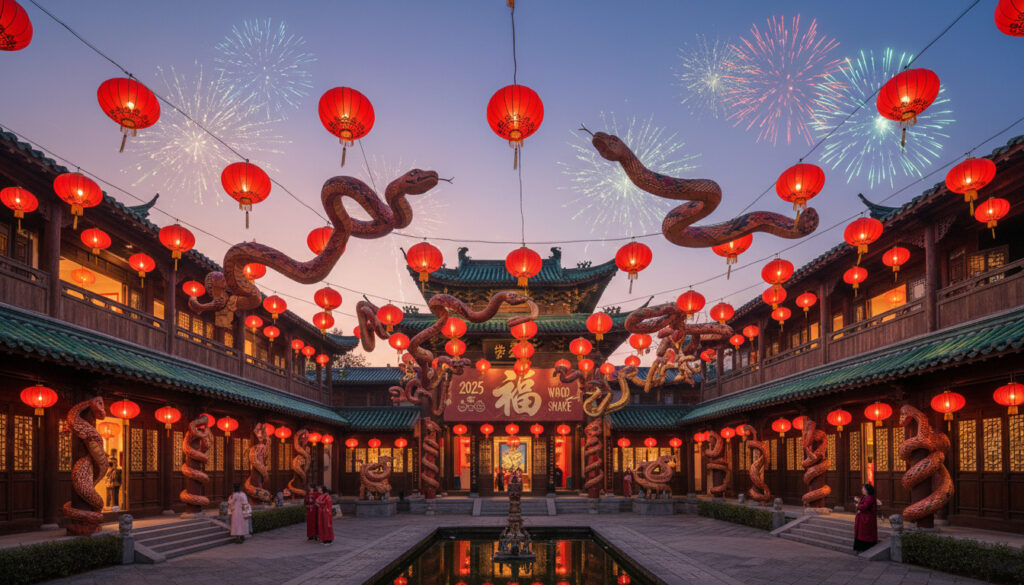
Lunar New Year 2025 – Dates, Wood Snake, Traditions
Chinese New Year 2025 arrives on Wednesday, January 29, marking the beginning of the Year of the Wood Snake across global communities. Known variously as the Spring Festival, Lunar New Year, or Tết in Vietnam, this annual observance follows the lunisolar calendar and represents the most significant traditional holiday for over a billion people. Festivities commence on the evening of January 28 with family reunions and extend through the Lantern Festival on February 12, encompassing sixteen days of ritual, renewal, and cultural celebration.
The 2025 holiday aligns with the second new moon following the winter solstice, placing it within the traditional window between January 21 and February 20. Calendar calculations confirm the precise timing stems from astronomical observations of lunar phases. Public holidays in mainland China officially span January 28 through February 4, incorporating weekends to create an approximately nine-day break for workers.
Celebrants worldwide prepare for the transition from the Dragon to the Snake, with the Wood element introducing specific characteristics of growth and adaptability to the zodiac cycle. The period emphasizes family reconciliation, ancestral veneration, and the symbolic sweeping away of misfortune to welcome prosperity.
When Is Lunar New Year 2025?
January 29, 2025
Wood Snake
16 Days
Renewal & Strategy
- Official celebrations begin January 28 evening with reunion dinners
- First day of the new year falls on Wednesday, January 29
- Festivities conclude February 12 at the Lantern Festival
- China observes a public holiday from January 28 through February 4
- The date shifts annually based on lunisolar cycles tied to the winter solstice
- Over 20 countries recognize the holiday with varying durations
| Aspect | 2025 Details |
|---|---|
| Official Start Date | Wednesday, January 29 |
| New Year’s Eve | Tuesday, January 28 |
| Lantern Festival End | Wednesday, February 12 |
| Zodiac Animal | Snake (Wood) |
| Element | Wood (growth, flexibility) |
| Public Holiday (China) | January 28 – February 4 (~9 days) |
| Total Festival Period | 16 days (Eve to Lantern Festival) |
| Lucky Numbers | 2, 8, 9 |
What Animal Represents 2025 in the Chinese Zodiac?
The 2025 cycle ushers in the Year of the Snake, specifically the Wood Snake within the 60-year elemental cycle. Snake years recur every twelve years, with previous occurrences in 2013 and subsequent returns in 2037. Chinese zodiac records indicate the Snake occupies the sixth position in the twelve-animal sequence, following the Dragon and preceding the Horse.
The Wood element combines with the Snake to emphasize creativity, strategic growth, and adaptability. Traditional interpretations associate Snake years with wisdom, intuition, and transformation. The complete zodiac sequence includes Rat, Ox, Tiger, Rabbit, Dragon, Snake, Horse, Sheep, Monkey, Rooster, Dog, and Pig.
What Does the Year of the Snake Mean?
Cultural associations for Snake years focus on steady progress through careful calculation rather than sudden moves. The Wood Snake specifically suggests prosperity achieved through flexible strategies and creative problem-solving. Traditional forecasts predict measured advancement in career and relationship matters for those born under this sign, with emphasis on caution regarding unnecessary risks.
The Wood Snake combination encourages growth and renewal. Wood represents upward movement and flexibility, potentially softening the Snake’s typical intensity with adaptive energy. Travel China Guide notes that Wood years favor educational pursuits and long-term planning over impulsive decisions.
Are There Specific 2025 Predictions?
Available sources lack detailed horoscope predictions specifically calibrated for 2025. General zodiac characteristics apply: Snake years traditionally symbolize periods favoring research, introspection, and methodical advancement. The Wood element adds dimensions of artistic expression and environmental consciousness to these baseline interpretations. Individual forecasts would require consultation with specialized astrological practitioners.
What Are the Key Traditions of Lunar New Year?
Core observances center on family cohesion, ritual purification, and symbolic protection against negative influences. Traditional practices documented across communities emphasize renewal through specific food preparations, color symbolism, and temporal taboos.
How Do Families Celebrate Together?
New Year’s Eve gatherings constitute the festival’s emotional core. Families convene for reunion dinners featuring symbolic foods: dumplings representing wealth accumulation, fish suggesting abundance through homophonic association, and rice cakes implying upward progress. Cultural education resources highlight that menu selections carry specific prognostic significance for the coming year.
What Role Do Colors and Decorations Play?
Red dominates visual landscapes through lanterns, paper cuttings, and door couplets. Adults present monetary gifts in red envelopes (hongbao) to children and unmarried juniors. The color traditionally repels the mythical Nian monster while attracting fortune. Green and black additionally receive emphasis during Wood Snake years, harmonizing with the elemental associations of growth and water.
Sources indicate lucky numbers 2, 8, and 9 carry particular significance for 2025, representing pairing, infinity, and longevity respectively. The Wood element suggests incorporating natural materials and green tones into decorations. Regional customs vary regarding specific color assignments, with some traditions emphasizing gold for prosperity alongside the standard red.
What Preparations and Taboos Apply?
Thorough house cleaning occurs before New Year’s Eve to sweep away accumulated misfortune. During the festival itself, celebrants avoid using brooms that might “brush away” incoming luck. Arguments and references to death or misfortune remain suppressed. White clothing stays relegated to wardrobes as it traditionally associates with mourning and funerary contexts.
How Does the Festival End?
The Lantern Festival on February 12 marks the formal conclusion. Communities display illuminated lanterns, solve riddles attached to displays, and consume tangyuan—sweet glutinous rice balls symbolizing family unity and completeness. This fifteenth-day observance transitions the spiritual focus from ancestral veneration toward community engagement and romantic connections.
Where and How Is Lunar New Year Celebrated Globally?
The observance extends far beyond mainland China, adapting to local cultural contexts while maintaining lunar timing. Wikipedia’s cultural mapping identifies over twenty countries recognizing the holiday, including Myanmar, Cambodia, Indonesia, and Brunei, alongside major diaspora populations worldwide.
| Region | Local Name | Duration | Distinctive Customs |
|---|---|---|---|
| China | Spring Festival | ~9 days public | Mass travel (chunyun), family banquets |
| Vietnam | Tết | Varies | Bánh chưng cakes, ancestor worship, peach blossoms |
| South Korea | Seollal | 3 days | Hanbok dress, ancestor rites, traditional games |
| Malaysia/Singapore | Chinese New Year | 2 days | Open houses, lion dances |
| Taiwan | Lunar New Year | 4+ days | Temple visits, pinwheel rockets |
| Hong Kong/Macau | Lunar New Year | 3 days | Fireworks, horse racing |
Vietnam’s Tết substitutes yellow flowers and square sticky rice cakes emphasizing earth elements, diverging from Chinese red symbolism. Korean Seollal notably excludes fireworks, focusing instead on ancestral rituals and folk games like yut nori. Educational comparisons confirm that while lunar timing unifies these observances, specific foods, dances, and ritual emphases diverge significantly by national culture.
How Does the 16-Day Festival Progress?
-
Family reunion dinners commence at night. Homes decorated with red couplets. Fireworks at midnight to repel the Nian monster.
-
Welcome the Year of the Snake. Visit elders and temples. Strict taboo against sweeping or using sharp objects. Children receive hongbao.
-
Extended family visits and gift exchanges. Married daughters traditionally return to their parents’ homes on Day 2.
-
Conclusion of China’s official break. Return travel peaks (chunyun).
-
Fifteenth day celebrations with tangyuan consumption. Riddle-solving games. Dragon dances conclude the cycle.
What Is Certain Versus Uncertain About 2025?
| Established Facts | Uncertain or Variable Information |
|---|---|
| Exact date: January 29, 2025 | Specific hourly auspicious timings for rituals (vary by region and astrologer) |
| Zodiac animal: Wood Snake | Detailed personalized horoscope predictions (sources lack specific 2025 forecasts) |
| Duration: 16 days (Eve to Lantern Festival) | Exact lucky color lists (regional variations exist; green/red consensus is general) |
| Lucky numbers: 2, 8, 9 | Scientific verification of zodiac predictions (astrological, not empirical) |
| Public holiday: China Jan 28-Feb 4 | Private sector compliance with holiday schedules (varies by employer) |
Why Do the Dates Shift Every Year?
The lunisolar calendar governs timing, requiring coordination between solar years and lunar months. Chinese New Year occurs on the second new moon following the winter solstice, placing it between January 21 and February 20 annually. This astronomical calculation ensures agricultural and seasonal alignment traditional to Han Chinese calendrical science.
The 2025 positioning reflects the moon’s phases relative to the December 2024 solstice. Each year’s shift accommodates the eleven-day difference between the 354-day lunar year and solar calendar, corrected through intercalary months every three years. This mathematical foundation explains why Western calendar dates vary while the lunar observance remains fixed in celestial time.
What Sources Inform This Guide?
Factual assertions derive from astronomical calendar databases, tourism authorities, and cultural education organizations. CalendarDate.com provides precise date calculations. Travel China Guide supplies zodiac and regional customs data. Time Out documents contemporary celebrations and lucky elements. NAEYC contributes educational perspectives on global variations.
The traditional Chinese New Year was the most important festival on the calendar, with its history traced back thousands of years.
— Encyclopedic documentation of historical continuity
How Should Communities Prepare?
The transition to the Wood Snake on January 29 offers communities a structured opportunity for renewal and strategic planning. Whether observing through intimate family meals or public cultural displays, the sixteen-day period emphasizes continuity across generations. Those interested in comparative holiday traditions will recognize parallel themes of light, renewal, and family reunion across winter festivals globally. Advanced preparation for travel, gift procurement, and ritual observances should account for the mass migration patterns characteristic of chunyun.
Frequently Asked Questions About Lunar New Year 2025
What color is lucky for 2025?
Green, black, and red receive emphasis for the Wood Snake year. Green harmonizes with the Wood element representing growth, while red maintains its traditional protective and fortune-attracting properties.
What are the Lunar New Year 2025 predictions?
Specific 2025 horoscope details remain unavailable in current sources. Generally, Snake years favor wisdom and careful strategy over risk-taking, with the Wood element adding creative and adaptive qualities.
What are the differences between Chinese New Year and Lunar New Year?
“Chinese New Year” and “Lunar New Year” often refer to the same date, but “Lunar New Year” encompasses variations like Vietnam’s Tết and Korea’s Seollal, which feature distinct foods, costumes, and ritual emphases.
How long does the holiday last in 2025?
The full festival spans sixteen days from January 28 to February 12. China’s public holiday covers approximately nine days from January 28 through February 4.
What foods are traditionally served?
Dumplings (wealth), fish (abundance), and rice cakes (progress) dominate New Year’s Eve menus. The Lantern Festival concludes with tangyuan sweet rice balls symbolizing family unity.
Which countries celebrate besides China?
Over twenty countries recognize the holiday, including Vietnam, South Korea, Singapore, Malaysia, Indonesia, Brunei, and the Philippines, plus diaspora communities worldwide.
Is the Year of the Snake related to the Year of the Rabbit?
The Snake follows the Rabbit in the zodiac sequence, representing a shift from the previous 2024 cycle. Both animals appear in the twelve-year rotation, with the Snake occupying the sixth position.
More related posts
 Lenovo IdeaPad Slim 3 Review: I It Worth Buying? (2025)
 Fried Rice Shrimp Near Me: Best Spots, Health Facts & Delivery
 Jim Belushi Today: Net Worth, Cannabis Farm, and More
 Singin’ in the Rain: Movie Facts, Cast Drama & Song History
 90000 USD to CAD – Live Rates, History & Exchange Tips
 Healthy Snacks for Kids: 10 Easy Ideas and Crisps Swaps
 How to Multiply Decimals: Step-by-Step Guide with Examples
 What Time Does It Get Dark? Ireland Sunset & Twilight Guide