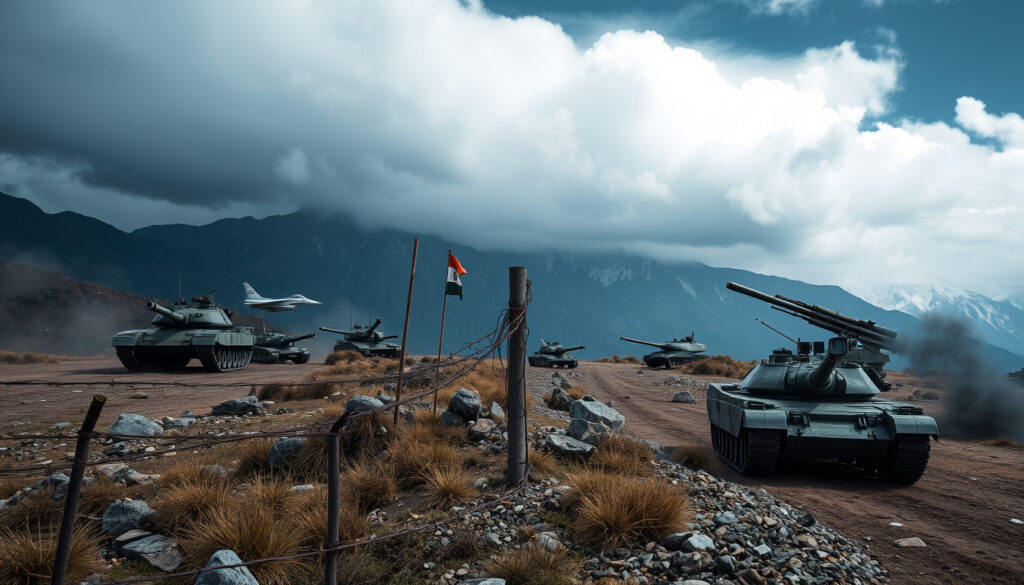
India Pakistan War News: 2025 Crisis, Military Power Comparison
On April 22, 2025, a terrorist attack in Pahalgam killed 26 civilians, setting in motion a sequence of military escalations that few observers thought possible between two nuclear-armed neighbors. Four days later, a ceasefire brought the fighting to a halt—but not before both sides had struck deeper into each other’s territory than at any point in fifty years, according to a U.S.-China Economic and Security Review Commission report. This article walks through what happened, who has the stronger military hand, and what the standoff means going forward.
Crisis Start: 7 May 2025 ·
Trigger Event: India missile strikes in Pakistan ·
Pakistan Response: Army counteraction ·
Key Focus: India-Pakistan tensions ·
Military Debate: India vs Pakistan power 2025
Quick snapshot
- India launched Operation Sindoor on May 7, 2025 (Wikipedia – 2025 India-Pakistan conflict)
- A ceasefire was announced on May 10, 2025 (Wikipedia – 2025 India-Pakistan crisis)
- Whether the May 7 S-400 interception of all eight Pakistani missiles actually succeeded
- Full extent of civilian damage in Poonch and Jammu districts
- Escalation from March 17 Uri skirmish to full conflict in under two months (Defense Feeds – conflict analysis)
- Both countries deployed new armor and artillery near the Line of Control starting January 2025 (Defense Feeds – conflict analysis)
- Diplomatic relations remain severed; Indus Waters Treaty suspension still in effect
- Regional analysts watch for whether China’s post-conflict defense diplomacy reshapes South Asian alliances
| Label | Value |
|---|---|
| Crisis Date | 7 May 2025 |
| India Action | Missile strikes in Pakistan |
| Pakistan Action | Military response |
| Sources | Wikipedia, Al Jazeera, BBC |
Which army is more powerful, India or Pakistan?
The raw numbers favor India by a wide margin. According to the 2025 Global Firepower Index, India ranks fourth globally while Pakistan sits at 12th (Times of India). India’s military balance remains heavily tilted in its favor across personnel, budget, technology, and conventional forces. The gap narrows considerably when it comes to nuclear arsenals, where both sides maintain comparable deterrence capabilities.
India vs Pakistan Military Power 2025
Three metrics stand out in any comparison between the two forces.
India’s larger and more modern military, combined with its advanced missile and nuclear capabilities, provides significant strategic depth—but Pakistan’s concentrated, Pakistan-focused force structure and Chinese-supplied air defenses create real asymmetries that favor neither side in a direct conventional exchange.
| Domain | India | Pakistan |
|---|---|---|
| Global Military Ranking (2025) | 4th | 12th |
| Personnel & Budget Edge | Substantially larger | Smaller but focused |
| Key Strength | Missiles, nuclear, navy, air force | Air defense, border positioning |
The Times of India notes that India’s larger and more modern military, combined with its advanced missile and nuclear capabilities, provides it with significant strategic depth. Pakistan counters with concentrated air defense systems—including Chinese HQ-9 batteries and PL-15 missiles—that proved effective during the May 2025 strikes.
Who won India-Pakistan wars?
India and Pakistan have fought four major wars since 1947—in 1947–48, 1965, 1971, and 1999—along with numerous border skirmishes and the 2019 Pulwama-Balakot exchange. India won decisively in 1971, which resulted in Bangladesh’s independence. The 1965 war ended in a stalemate. The 1999 Kargil conflict saw India regain control of lost positions after intense fighting.
List of Wars Between India and Pakistan
Five conflicts have defined seven decades of hostilities.
| Conflict | Year | Outcome |
|---|---|---|
| First Kashmir War | 1947–48 | Armistice, Kashmir divided |
| Second Kashmir War | 1965 | Stalemate, UN resolution |
| Third Kashmir War | 1971 | India victory, Bangladesh created |
| Kargil War | 1999 | India regained positions |
| 2025 Crisis | 2025 | Ceasefire, no clear victor |
The historical record shows India winning the only conflict where it achieved total military dominance, but losing political capital in narrower clashes. The 2025 crisis fits the pattern of inconclusive outcomes that have characterized most India-Pakistan military standoffs.
Year, Cause, Outcome
Each major conflict had distinct triggers. The 1947–48 war grew from Partition’s chaos. The 1965 war escalated from border disputes in Kashmir. The 1971 war erupted over Bangladesh’s independence struggle. Kargil in 1999 began when Pakistani forces crossed the Line of Control. The 2025 crisis followed a terrorist attack in Pahalgam that killed 26 civilians on April 22.
India suspended the Indus Waters Treaty on April 23, 2025—an action without precedent in the Treaty’s 65-year history. The move affects water sharing for hundreds of millions downstream in Pakistan, raising humanitarian stakes far beyond the immediate military confrontation.
Has the Pakistan and India war ended?
A ceasefire was announced on May 10, 2025, following an agreement between India and Pakistan, ending the four-day conflict that began on May 7. Both countries remain in a state of suspended hostility: diplomatic ties severed, visas cancelled, and the Indus Waters Treaty suspension still in effect.
India Pakistan War News Today LIVE
The immediate fighting stopped, but the situation on the ground remains volatile. Satellite imagery from January–February 2025 showed armored vehicle deployments and new artillery placements by both countries within 5 km of the Line of Control. India’s Northern Command conducted Operation Vigil Edge in January 2025, a large-scale military exercise near the border which Pakistan denounced as an “act of intimidation.”
Ceasefire violations along the line of control between April 25 and May 6 became frequent, with cross-border shelling intensifying before the May 7 strikes.
Current Status
Pakistan’s Army launched a blitz on Poonch and Jammu on May 7, 2025, killing 16 civilians and leaving hundreds of homes destroyed. At least five people were killed in Pakistani shelling in Rajouri, Poonch, and Jammu districts. A skirmish along the Line of Control in the Uri sector on March 17, 2025, escalated into a sustained artillery duel, officially beginning the 2025 India-Pakistan conflict.
The implication: both sides have used every prior ceasefire as a staging ground for the next escalation cycle. Analysts watch whether 2025 follows the same script.
Whose navy is strong, India or Pakistan?
India holds a decisive advantage in naval capabilities. The Indian Navy operates an aircraft carrier, multiple destroyers, and frigates, giving it blue-water reach that Pakistan’s navy cannot match. On May 9, India repositioned its Western Fleet—including an aircraft carrier, destroyers, frigates, and anti-submarine warfare ships—in the northern Arabian Sea within operational range of Karachi.
Indian Navy vs Pakistan Navy Strength
Two factors define the naval balance.
- India’s carrier-based aviation allows power projection far from its coasts. Pakistan has no equivalent capability.
- Pakistan’s maritime strategy focuses on denial rather than projection—keeping Indian forces away from its coast rather than projecting power outward.
India’s naval repositioning near Karachi in May 2025 was a show of force rather than a decisive action. Pakistan’s coastal defenses, supplied by China, created enough risk that India did not pursue direct naval strikes.
Power Comparison
Pakistan used Chinese-made air defenses including the HQ-9, PL-15, and Chengdu J-10 platforms during the conflict. Pakistan’s use of Chinese weapons systems to shoot down Indian aircraft became a selling point in China’s post-conflict defense diplomacy. Pakistan’s forces achieved military success over India according to the 2025 U.S.-China Economic and Security Review Commission report—a characterization that complicates any simple narrative of Indian superiority.
The pattern: China’s defense diplomacy after the conflict promoted Pakistani success with Chinese systems as evidence of their reliability, reshaping regional security partnerships.
Who is the no. 1 army in the world?
The United States holds the top spot in the Global Firepower Index, followed by Russia and China. India ranks fourth globally, and Pakistan ranks twelfth. Both sit outside the top tier but command significant regional influence and nuclear arsenals that place them in any serious global security conversation.
List of Most Powerful Military Forces 2025
- United States — top tier, global reach
- Russia — second tier, nuclear backbone
- China — second tier, expanding blue-water navy
- India — fourth, dominant in South Asia
- Pakistan — twelfth, nuclear-armed regional power
India and Pakistan Positions
The gap between India’s fourth-place ranking and Pakistan’s twelfth-place ranking understates Pakistan’s capabilities in a direct India-Pakistan scenario. Pakistan’s concentrated force structure, designed specifically for potential conflict with India, creates an asymmetry that the raw Global Firepower ranking does not capture. The New York Times reported that India struck targets deeper inside enemy territory than it had struck in previous decades—but also characterized the overall result as “little more than a draw.”
The implication: global rankings obscure the specific asymmetries that matter most in a South Asian confrontation.
Related reading: AI 185 Flight Status DEL to YVR · 1 Euro to INR
defencejournal.com, youtube.com, youtube.com, youtube.com, nbr.org, stimson.org
The 2025 crisis echoes key war conflicts such as Operation Sindoor, where India struck nine targets deep inside Pakistan.
Frequently asked questions
Why did Pakistan start a war with India?
Pakistan did not initiate the 2025 conflict. A terrorist attack in Pahalgam on April 22, 2025, killed 26 civilians. India responded with Operation Sindoor on May 7, targeting terrorist infrastructure in Pakistani-administered territory. Pakistan’s subsequent counter-strikes were framed as retaliation rather than initiation.
Who is Pakistan’s biggest friend?
China is widely regarded as Pakistan’s closest military and diplomatic partner. During the May 2025 conflict, Pakistan deployed Chinese-made HQ-9 air defense systems, PL-15 missiles, and Chengdu J-10 fighter aircraft. China’s post-conflict defense diplomacy promoted these systems as combat-proven, suggesting an intensified security relationship.
What is the current India Pakistan border news?
The ceasefire signed on May 10, 2025, holds nominally, but no diplomatic channel has reopened. India suspended the Indus Waters Treaty on April 23, 2025—an unprecedented move in 65 years of the agreement’s history. Visa restrictions remain in place. Both sides maintain enhanced military deployments along the Line of Control.
Is there India Pakistan war news 2025 today?
Active fighting ended on May 10, 2025. As of the latest available reporting, the ceasefire holds, but tensions remain elevated. Regional analysts monitor for ceasefire violations and whether diplomatic channels reopen before the treaty suspension creates humanitarian pressure.
What are India Pakistan latest news today?
The most significant ongoing development is the suspension of the Indus Waters Treaty, which governs river water sharing between the two countries. This suspension, unprecedented in the Treaty’s history, threatens water security for hundreds of millions of people in Pakistan who rely on rivers originating in India.
Which country has stronger military overall?
India has a stronger military overall by most quantitative measures—fourth in the Global Firepower ranking versus Pakistan’s twelfth place. However, Pakistan’s military is specifically optimized for India-Pakistan scenarios, and its Chinese-supplied air defenses performed effectively during the May 2025 conflict. In a nuclear context, neither side can achieve decisive victory without unacceptable costs.
The Indus Waters Treaty suspension stands as the most consequential long-term consequence of the 2025 crisis. An estimated 500 million Pakistanis depend on rivers governed by the treaty. If the suspension becomes permanent, it could redefine water security across South Asia and create humanitarian pressure that no ceasefire agreement addresses.
For Pakistan, the path forward is constrained: it cannot afford a prolonged military standoff against a wealthier neighbor, but it also cannot appear weak on issues of territorial integrity. The New York Times reported that India felt frustrated after Donald Trump’s public claims of mediating a ceasefire, which presented both countries as equals and downplayed the terrorist attack that triggered the conflict. This diplomatic friction suggests that external mediation efforts may face resistance from India, complicating any return to normalized relations.
“Both countries struck targets deeper into each other’s territories than at any time in fifty years.”
— U.S.-China Economic and Security Review Commission, 2025 report
“The result of the conflict was little more than a draw.”
— The New York Times, 2025 conflict analysis
More related posts
 Jaskirat Singh Rangi: Fictional Agent vs Real Major Mohit Sharma
 Macaulay Culkin: 2004 Drug Arrest, Sobriety, Net Worth
 Pembina Trails School Division: Website, Calendar, Portal Guide
 Chris Rea Cause of Death: Health, Net Worth, and Final Years
 Great Canadian Oil Change Coupon – $20 Off Verified Deals
 Lee Priest: Career, Tattoo Removal, and Mr. Olympia Record
 90000 USD to CAD – Live Rates, History & Exchange Tips
 Lenovo IdeaPad Slim 3 Review: I It Worth Buying? (2025)