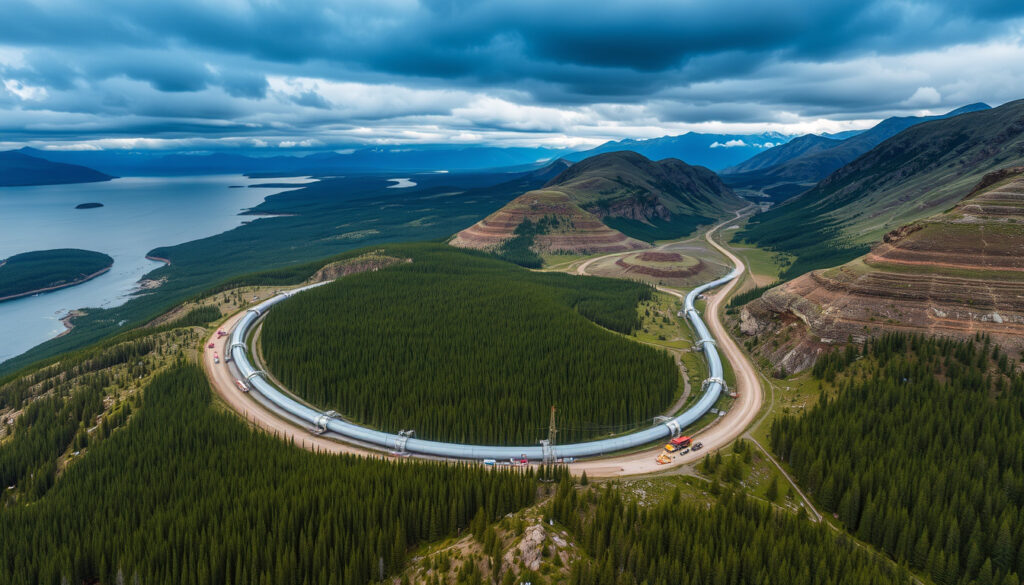
Trans Mountain Pipeline News – Status, Costs and Impacts
The Trans Mountain Pipeline Expansion (TMX) has emerged as one of Canada’s most significant infrastructure developments in recent memory. After years of debate, legal battles, and construction challenges, the expanded pipeline system officially began commercial operations on May 1, 2024, fundamentally altering the landscape of Canadian energy exports and market access.
The project, which tripled the original capacity from 300,000 to 890,000 barrels per day, connects Alberta’s oil-producing regions to British Columbia’s Pacific coast. This connection has opened new pathways for Canadian crude oil to reach international markets beyond traditional North American destinations, marking a potential shift in the country’s energy trade dynamics.
The journey to completion, however, was far from straightforward. Government acquisition, ballooning costs, widespread protests, and regulatory hurdles characterized the project’s complex history. Understanding the full scope of this infrastructure milestone requires examining its current status, the controversies that surrounded it, and the economic implications now unfolding.
What is the Latest News on the Trans Mountain Pipeline?
As of late 2025, the Trans Mountain Pipeline Expansion operates at full commercial capacity, with oil flowing steadily from Edmonton, Alberta, to the Westridge Marine Terminal in Burnaby, British Columbia. The transition from construction to operations has enabled Canada to diversify its energy export destinations, with non-U.S. crude exports rising from 3 percent to 14 percent of total oil exports by the fourth quarter of 2025.
Statistics Canada data shows crude oil movements reached 630,555 cubic meters in May 2024 alone, marking the first full month of expanded pipeline operations. The impact on market pricing has been substantial—by June 2024, the price gap between U.S. light crude and Alberta heavy blends had narrowed by 37.5 percent, generating approximately US$16.7 billion in additional industry revenues through November 2025.
The expanded pipeline has significantly improved price realization for Canadian heavy crude, reducing the historical discount that Alberta producers faced when selling to U.S. refineries exclusively. Industry analysts point to this as a primary economic driver behind the project’s justification.
Recent operational developments include the publication of the 2024 ESG report, quarterly financial disclosures through Q1 2025, and a binding open season for firm service on existing capacity. A further capacity expansion remains in regulatory review, according to statements from Trans Mountain Corporation.
Key Operational Insights
- Commercial operations commenced May 1, 2024, following mechanical completion
- Non-U.S. oil exports increased from 3% to 14% of total Canadian crude exports
- Price differential between Alberta heavy crude and U.S. light crude narrowed by 37.5%
- Industry revenues boosted by approximately US$16.7 billion through late 2025
- Additional capacity expansion currently under regulatory review
- Government retention of ownership cited for economic benefit projections
| Fact | Details |
|---|---|
| Operations Start | May 1, 2024 |
| Total Length | Approximately 1,150 km |
| Daily Capacity | 890,000 barrels per day |
| Final Cost | C$34 billion |
| Current Owner | Trans Mountain Corporation (Federal Crown Corporation) |
| Route Terminus | Westridge Marine Terminal, Burnaby, BC |
Has the Trans Mountain Pipeline Expansion Been Completed?
Yes, the Trans Mountain Pipeline Expansion has been fully completed and entered commercial service on May 1, 2024. Construction milestones tracked progress through early 2024, with the project reaching 98 percent completion in January 2024 before line fill operations commenced in March and April of that year.
The expansion effectively triples the original system’s throughput capacity. Where the original pipeline moved approximately 300,000 barrels per day, the expanded system now handles up to 890,000 barrels daily—approaching one million barrels at maximum capacity. This represents a fundamental shift in Canada’s pipeline infrastructure and its ability to access global oil markets.
The route follows the original pipeline corridor for much of its distance, running parallel to the existing infrastructure from Edmonton to Burnaby. At its terminus, the expanded system connects to the Westridge Marine Terminal, purpose-built to accommodate larger vessels for international shipments.
Construction Timeline Highlights
- Federal government acquisition completed in 2018
- Construction reached halfway point in April 2022
- Three-quarters of pipe in place by January 2023
- Final sections completed and tested through early 2024
- Line fill operations concluded by April 2024
Why is the Trans Mountain Pipeline Controversial?
The Trans Mountain Pipeline Expansion generated intense controversy throughout its development, with opposition emerging from Indigenous groups, environmental organizations, British Columbia municipalities, and climate policy advocates. The debates centered on multiple interconnected concerns spanning ecological protection, Indigenous rights, climate obligations, and economic trade-offs.
Environmental opponents raised specific concerns about spill risks along the marine route through the Salish Sea, potential impacts on endangered killer whale populations, and the broader implications for Canada’s climate commitments. The pipeline corridor passes through ecologically sensitive terrain, including areas adjacent to protected waters and wildlife habitats.
Environmental assessments conducted by the Canada Energy Regulator formed part of the federal approval process, though ongoing monitoring of marine ecosystems and spill prevention remains an area of public interest and regulatory attention.
Indigenous communities along the route expressed divergent views, with some groups supporting economic development opportunities while others opposed the project based on consultation concerns and territory rights. Several Indigenous nations pursued legal challenges that contributed to project delays, arguing that consultation processes fell short of constitutional requirements.
Legal challenges repeatedly interrupted the project’s timeline, with multiple court cases examining federal approval processes and Indigenous consultation adequacy. The federal government ultimately re-approved the project in 2019 through Governor in Council direction after earlier approvals were overturned by courts.
Key Controversy Themes
- Marine ecosystem protection in the Salish Sea region
- Indigenous rights and consultation adequacy
- Spill response capabilities and emergency preparedness
- Canada’s climate commitments and carbon emissions
- Economic benefits versus environmental costs
- Property rights and landowner concerns
What is the Cost and Ownership of the Trans Mountain Pipeline?
The Trans Mountain Pipeline Expansion represents one of the most expensive infrastructure projects in Canadian history, with final costs reaching approximately C$34 billion. This figure represents a dramatic escalation from initial estimates of approximately C$7.4 billion, though one independent estimate placed potential costs as high as C$53 billion during various project phases.
The federal government acquired the original Trans Mountain pipeline system from Kinder Morgan in 2018 for C$4.5 billion, establishing Trans Mountain Corporation as a Crown corporation to own and operate the system. In April 2022, the corporation received non-agent status for financing purposes, enabling it to access capital markets independently for the expansion costs.
Despite ongoing discussions about potential divestiture, the government has maintained ownership through Trans Mountain Corporation, citing projected economic benefits including C$9.2 billion in gross domestic product contribution and C$2.8 billion in tax revenues through 2043. Critics have questioned whether these projections adequately account for construction cost overruns and ongoing operational expenses.
The Canada Development Investment Corporation manages Trans Mountain Corporation on behalf of the federal government. The decision to retain ownership rather than sell to private interests has remained a policy debate point, with proponents emphasizing strategic market access and opponents advocating for reduced government involvement in commercial energy ventures.
Cost Evolution Summary
| Phase | Estimated Cost |
|---|---|
| Original Pipeline (1953) | Not publicly disclosed |
| Expansion Initial Estimate | C$7.4 billion |
| Pre-construction Estimate | C$30.9 billion |
| Final Reported Cost | C$34 billion |
| Federal Purchase Price | C$4.5 billion |
What is the History and Timeline of the Trans Mountain Pipeline?
The Trans Mountain pipeline system traces its origins to 1953, when the original pipeline was constructed to transport crude oil and refined petroleum products—including jet fuel, gasoline, and diesel—from Alberta to British Columbia. The original system spans approximately 1,150 kilometers, establishing critical energy infrastructure for western Canada.
Proposals to expand capacity emerged in 2013, driven by industry interest in accessing Pacific Rim markets and accommodating growing oil sands production. The expansion concept involved twinning the existing line, essentially constructing a parallel pipeline for most of the route to triple system capacity.
Timeline of Major Events
- 1953: Original Trans Mountain Pipeline constructed, spanning 1,150 kilometers
- 2013: Expansion proposal formally introduced to triple capacity
- 2017: British Columbia government signals conditional support for expansion
- 2018: Federal government acquires Trans Mountain system from Kinder Morgan for C$4.5 billion
- 2019: Federal cabinet issues re-approval after court overturns initial authorization
- April 2022: Construction reaches 50 percent completion milestone
- January 2023: Three-quarters of pipeline segments installed
- January 2024: Project reaches 98 percent completion
- March-April 2024: Line fill operations conducted
- May 1, 2024: Commercial operations officially commence
What is the Route and Capacity of the Trans Mountain Pipeline?
The Trans Mountain Pipeline system extends approximately 1,150 kilometers from Edmonton, Alberta, westward and southward through mountainous terrain to the Greater Vancouver area. The expanded system parallels the original corridor for virtually its entire length, utilizing existing right-of-way where possible while requiring new easements in certain segments.
The route traverses diverse landscapes including boreal forest, agricultural regions, and mountainous terrain before reaching the Pacific coast at Burnaby. The Westridge Marine Terminal, located within the Metro Vancouver area, serves as the pipeline’s terminus and provides loading capabilities for crude oil tankers bound for international destinations.
Daily capacity stands at 890,000 barrels per day under normal operating conditions, with the system designed to approach one million barrels per day at peak throughput. This compares to the original pipeline’s capacity of 300,000 barrels per day, representing a near-tripling of potential throughput. The Canada Energy Regulator maintains oversight of pipeline operations and safety standards.
What is Established Versus Uncertain About the Trans Mountain Pipeline?
| Established Facts | Remaining Uncertainties |
|---|---|
| Commercial operations began May 1, 2024 | Timeline for potential government divestiture |
| Total cost reached C$34 billion | Long-term environmental monitoring outcomes |
| System capacity is 890,000 bpd | Scope and timing of future capacity expansion |
| Government owns Trans Mountain Corporation | Resolution of outstanding legal challenges |
| Non-U.S. exports have increased significantly | Impact on global oil pricing dynamics |
| Pipeline spans 1,150 km from Edmonton to Burnaby | Future regulatory requirements under new climate policies |
What Does the Trans Mountain Pipeline Mean for Canadian Energy?
The Trans Mountain Pipeline Expansion represents a strategic asset for Canadian energy security and international trade positioning. By establishing direct access to Pacific shipping routes, the pipeline enables Canadian crude oil to reach Asian markets—particularly in China, Japan, and South Korea—where demand for heavy petroleum products continues to grow.
The project has reshaped discussions about Canadian energy infrastructure needs, with industry advocates pointing to the economic benefits of diversified export markets. The narrowing of price differentials between Alberta heavy crude and international benchmarks demonstrates tangible value creation for Canadian producers and provincial royalty revenues.
Broader policy debates continue regarding the appropriate role of government in energy infrastructure, carbon pricing mechanisms, and Canada’s climate commitments under international agreements. The Alberta-federal memorandum of understanding establishing carbon prices reaching $130 per tonne reflects ongoing tensions between economic development and environmental objectives.
The expansion of the Trans Mountain pipeline has fundamentally altered Canada’s energy export capabilities, providing market access that was previously unavailable to Alberta producers.
— Government of Canada Economic Analysis, trans-mountain.ca
Summary: Trans Mountain Pipeline Status and Implications
The Trans Mountain Pipeline Expansion has completed its journey from controversial proposal to operational reality. With commercial operations underway since May 2024, Canada now possesses significantly enhanced capacity to export crude oil to non-U.S. markets, generating measurable benefits for the energy sector and provincial economies. The C$34 billion project faced sustained opposition, legal challenges, and cost escalations that characterized its development, yet emerged as functional infrastructure serving national economic interests.
Looking ahead, the pipeline’s role in Canadian energy policy remains subject to evolving environmental regulations, market dynamics, and government priorities. Ongoing capacity expansion proposals and potential ownership changes indicate that the Trans Mountain story continues to unfold. For those tracking Canadian energy developments, monitoring operational performance, export volumes, and regulatory proceedings will provide insights into this transformative infrastructure project’s lasting impact. For related economic analysis, see our guide on CPP Payment Increase 2026 – Amounts, Dates and Eligibility Guide.
Frequently Asked Questions
What is the capacity of the expanded Trans Mountain Pipeline?
The expanded pipeline can transport up to 890,000 barrels per day, nearly tripling the original 300,000-barrel capacity.
How long is the Trans Mountain Pipeline?
The pipeline system spans approximately 1,150 kilometers from Edmonton, Alberta, to the Westridge Marine Terminal in Burnaby, British Columbia.
What is the route of the Trans Mountain Pipeline?
The route follows the original corridor westward from Edmonton through Alberta, crossing mountainous terrain before reaching the Pacific coast at Burnaby, where it connects to the marine terminal for tanker loading.
When did the Trans Mountain Pipeline expansion start operations?
Commercial operations officially commenced on May 1, 2024, following mechanical completion and line fill procedures in early 2024.
Who owns the Trans Mountain Pipeline?
The federal government owns the pipeline through Trans Mountain Corporation, a Crown corporation established after the 2018 acquisition from Kinder Morgan.
What was the final cost of the Trans Mountain Pipeline expansion?
Final construction costs reached approximately C$34 billion, significantly exceeding initial estimates of C$7.4 billion.
What are the main controversies surrounding the pipeline?
Opposition centered on environmental concerns including marine ecosystem protection, Indigenous rights and consultation adequacy, spill risks, and Canada’s climate commitments.
More related posts
 Jason Robertson: Ethnicity, Contract, Injury, Stats & More
 Juice WRLD Death: Overdose, Last Words, Eminem, Net Worth
 Texas Flooding Flash Flood Camp Mystic – Timeline Causes Casualties
 Healthy Snacks for Kids: 10 Easy Ideas and Crisps Swaps
 Mariah Carey: Health, Debt, Family & Career Facts Revealed
 Paddy Pimblett Next Fight – Latest News on Date and Opponent
 Philadelphia Eagles vs Dallas Cowboys Match Player Stats – Full Box Score Breakdown
 Friedrich Merz: The 10th Chancellor of Germany and CDU Leader